


The Curious Backstory and Economic Underpinnings of the Trump Account
By J.R. Robinson, Financial Planner (February 2025)
The One Big Beautiful Bill Act (OBBBA) of 2025 was an omnibus‑style reconciliation bill that folded 28 related bills and dozens of proposals into one massive law. Included was a small but striking provision: a federal $1,000 seed contribution for children born between 2025 and 2028, invested in index funds and inaccessible until age 18. I might have overlooked this among OBBBA’s many moving parts, except that it sounded familiar. I realized it mirrored an idea I heard explained on an Acquired Podcast interview with hedge fund manager Brad Gerstner in March 2022, where he described “Invest America Accounts.” More on that in a moment.
Intellectual roots in universal income theory
The intellectual DNA of Trump Accounts comes from decades of work on universal basic income (UBI) and “asset‑based” welfare. UBI advocates have long argued that a rich country can and should provide every citizen with a minimum economic floor—either as guaranteed income or as publicly funded assets. Republicans have historically rejected UBI, but economists across the political spectrum worry about widening wealth gaps and the erosion of faith in capitalism when large parts of the population own no appreciating assets.
Trump Accounts channel a similar instinct—universal support—into long‑term investment capital seeded at birth. Instead of regular checks that are quickly spent, each child receives a government‑funded “stake” that compounds in diversified portfolios over time and becomes available for major life milestones. In spirit, the idea is close to the “baby bonds” proposals that have circulated in Democratic policy circles for years, but it is framed in a market‑friendly, investment‑first way that conservatives can embrace.
Brad Gerstner and the Invest America vision
Brad Gerstner, founder and CEO of Altimeter Capital, is widely credited with designing the original Invest America concept. Through his Invest America nonprofit and related advocacy, he argued that the U.S. faces an “existential crisis” if broad swaths of citizens never share in the upside of economic growth and market returns. His core thesis is that the health of a capitalist democracy depends on widespread ownership: if everyone has “skin in the game,” they are more likely to support and defend the system.
His proposal was to create federally sanctioned, tax‑advantaged investment accounts seeded at birth, open to contributions from parents, employers, philanthropists, and financial firms. Branded as “Invest America accounts,” they were pitched as a pro‑market response to the same concerns that motivate UBI: stagnant wages, rising asset prices, and deepening inequality. Public reporting noted genuine bipartisan interest and framed the concept as something that could plausibly sit in either a Democratic or Republican platform.
Although the legislative vehicle eventually emerged from conservative sponsors, coverage of Invest America and similar “baby bond” ideas made it clear that center‑left policy shops and figures in the Biden–Harris orbit were also exploring asset‑building tools for children. Gerstner’s strategy was to stress that inclusive capital ownership is not inherently partisan: giving every child a starting stake aligns with progressive concerns about inequality and conservative concerns about dependency.
From Invest America to Trump Accounts in OBBB
The political catalyst came when Senator Ted Cruz of Texas took up Gerstner’s framework and introduced it as the Invest America Act in the U.S. Senate. His bill proposed a private, tax‑advantaged account for each American child at birth, with a one‑time $1,000 federal seed contribution. Cruz framed the accounts in the language of opportunity and ownership: a way for every child to “climb the ladder” by participating in markets from day one instead of watching from the sidelines.
Cruz then pushed to incorporate the concept into what became the One Big Beautiful Bill Act (OBBBA), a sprawling tax‑and‑spending package that became a defining legislative vehicle for the Trump administration. The Invest America framework was folded into OBBBA and rebranded as “Trump Accounts,” tying the initiative to Trump’s broader promise to deliver tangible economic benefits for “forgotten” Americans.
Policy analysts at Brookings and elsewhere have described the structure as a rare bipartisan convergence: it preserves the universal, asset‑building ambitions long championed by Democrats but packages them as private, investment‑driven accounts more palatable to Republicans. Cruz has called the accounts the opposite of UBI: instead of an ongoing government check, every child gets a one‑time stake that relies on markets and voluntary contributions to grow.
How the pilot program works
Trump Accounts—formally Section 530A accounts in the tax code—are launching as a multi‑year pilot within OBBBA, with several key design elements.
Eligibility and seeding
Children born in the United States between 2025 and 2028 are eligible for a $1,000 initial deposit from the U.S. Treasury once an account is opened in their name. The law also contemplates “catch‑up” incentives: philanthropically funded contributions for millions of children under 10 who were born before 2025 and therefore do not qualify for the full federal seed.
To qualify for the federal seed, at least one parent must provide a Social Security number with work authorization, which excludes some U.S.‑born children of certain immigrant categories.
Account structure
Each account is a private, tax‑advantaged investment account, conceptually similar to a 529 plan but with broader uses and a dedicated federal seed. Funds are invested in diversified index funds approved by the Treasury, with taxes deferred on gains until withdrawal; distributions are taxed as ordinary income, akin to a traditional IRA. Families choose from a standardized menu of low‑cost index options, modeled on the government’s Thrift Savings Plan, to keep administration simple and fees low.
Contributions and matching
After the initial $1,000 deposit, parents, relatives, employers, financial firms, unions, community organizations, and philanthropies can contribute, subject to annual limits and existing gift‑tax rules. The pilot is explicitly designed to leverage matching commitments: the government seed is meant to be “matched” or supplemented by private actors, turning public dollars into much larger lifetime stakes for children.
Access and permitted uses
Like classic baby bond schemes, Trump Accounts are meant to remain invested through childhood and adolescence, with withdrawals generally restricted until at least age 18. Qualifying uses are expected to include higher education, first‑time home purchases, small‑business formation, and retirement rollovers—uses that build balance sheets rather than fund immediate consumption. Because OBBBA authorizes the accounts as a defined pilot through the late 2020s, Congress can evaluate participation, asset growth, and distributional impacts before deciding whether to expand or make the program permanent.
Private capital: Michael Dell, JPMorgan, and others
One of the most striking features of Trump Accounts is the scale of private capital lining up behind the program. Michael and Susan Dell pledged roughly $6.25 billion to fund $250 contributions for 25 million children under age 10, effectively extending smaller “pilot stakes” to cohorts that missed the $1,000 Treasury deposit. Their goal is to nudge families to claim accounts and to demonstrate how philanthropy can magnify modest federal outlays.
Gerstner, through personal philanthropy and his Invest America foundation, has committed to seeding accounts for children in Indiana, particularly those under age five. Other wealthy supporters, including hedge‑fund investors, have announced matching programs targeting specific regions or demographic groups, again using private dollars to expand the reach of the pilot beyond the congressional appropriation.
Corporate America is also engaging. JPMorgan Chase has pledged to match the government’s $1,000 contribution for employees’ children, doubling those accounts’ starting balances. Major financial firms such as BlackRock, BNY, Robinhood, SoFi, and Charles Schwab have announced similar matching offers, positioning Trump Accounts as a new kind of employee benefit and customer‑engagement tool. These commitments underscore that the program is designed as a public‑private partnership rather than a purely governmental scheme.
Bipartisan appeal and the fight against multigenerational poverty
Analysts emphasize that Trump Accounts occupy a rare bipartisan sweet spot: they are universal in design, progressive in distributional impact, and explicitly market‑driven. Republicans can point to the emphasis on private ownership, individual responsibility, and voluntary contributions from employers and philanthropists. Democrats and anti‑poverty advocates see an asset‑building platform that grows over time and is most consequential for children who would otherwise inherit little or nothing.
The potential impact on multigenerational poverty is significant. Even modest seeds can grow to meaningful sums over 18–25 years when invested in broad equity index funds, particularly when supplemented by employer and philanthropic matches. Estimates tied to Cruz’s proposal suggest that an initial $1,000 investment could grow to several thousand dollars in real terms by adulthood, with larger balances for families that contribute regularly or benefit from matching.
The deeper power of the accounts lies less in any single number and more in changing the default. Today, children in low‑wealth families often start adulthood with zero or negative net worth, while peers from affluent families receive help with college, down payments, or business capital. By making some level of investable capital universal—and by encouraging additional contributions from civil society—Trump Accounts could compress that initial wealth gap, reduce reliance on high‑interest consumer debt, and make upward mobility more realistic across generations.
Big ambitions, modest federal cost
Part of why the idea has moved quickly from think‑tank circles into law is its surprisingly low estimated federal price tag. In his Aquired interview Gerstner suggested a national Invest America‑style program could cost under $20 billion per year—a mere rounding error in the federal budget. Budget analyses of the Invest America framework and the OBBBA implementation similarly suggest that seeding $1,000 for each eligible newborn runs to only a few billion dollars annually. Because the government contribution is a one‑time grant rather than an open‑ended entitlement, and because much of the long‑term balance growth comes from market returns and private contributions, the federal footprint remains limited.
Private commitments dramatically amplify that public investment. The Dells’ $6.25 billion pledge alone rivals multiple years of federal seeding, and corporate matches and philanthropic funds further multiply the impact of each taxpayer dollar. That leverage is politically crucial: supporters can argue that the program has the potential to shift life trajectories for tens of millions of children while consuming only a sliver of the budget.
If the pilot performs as advocates hope—boosting account balances for low‑wealth families, improving financial literacy, and building durable political support for inclusive capital ownership—it could become the backbone of a new, asset‑based approach to fighting poverty. In that vision, Trump Accounts are not just another savings vehicle but a structural shift: from an economy where capital ownership is inherited by the few to one where every child begins life with a tangible stake in America’s future.
ADDENDUM
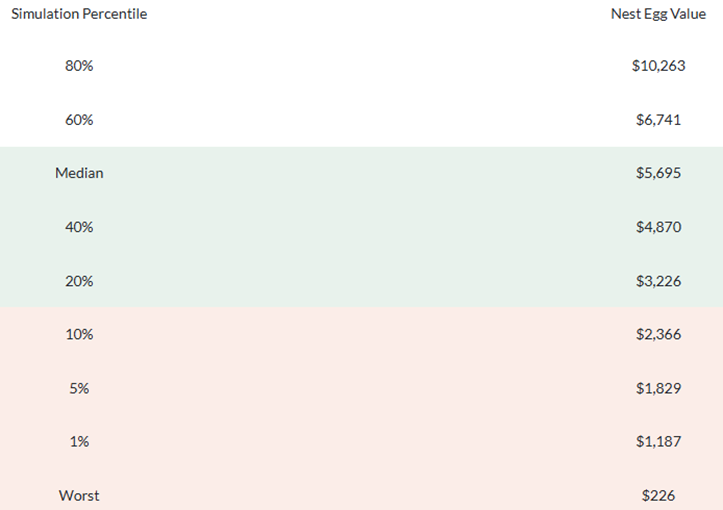
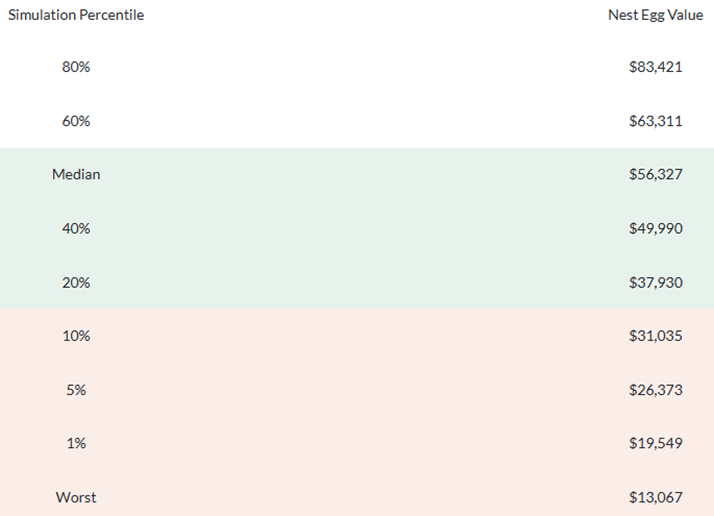
To make the impact of this program tangible, the simulations below project a realistic range of return scenarios assuming a $1,000 investment at birth in an S&P 500 Index fund with an expense ratio of 3 basis points (.03%). The tables are intended to show what the value of a a Trump Account might be if future investment returns from the stock market are above average, normal, below average, or awful.
Scenario 1: $1,000 invested at birth with no additional contributions for 18 years.
Scenario 2: $1,000 invested at birth and each year to age 18.
RELATED READING